
Birds Tell the Story: Getting to Know the Birds of HAT-Protected Lands
By Trentön Schulz-Franco
From the forest floor to the tops of old conifers, birds are constantly moving through the landscapes HAT works to steward.
In 2026, HAT's Land Protection monitoring included 15 bird surveys between May and August, documenting birds using protected and partner-monitored lands throughout the spring and summer. These observations give us glimpses into the relationships between birds and the habitats around them: trees that provide nesting cavities, insects hidden beneath bark, berries and seeds that fuel migration, wetlands that provide food and shelter, and snags and open forest edges that become hunting perches. Many of these birds are surprisingly dependent on particular pieces of their surrounding habitats.
Meet the Neighbours
Salmonberry Thrush
The Salmonberry Thrush (sometimes referred to as the Swainson’s Thrush) is one of the sounds of summer in coastal forests. Its ethereal, spiraling song can carry surprisingly far through the trees, but the bird itself is often much harder to find. Salmonberry Thrushes forage on insects and other invertebrates during the breeding season, while berries and fruit become increasingly important at other times of year. They are closely associated with forest habitat with a well-developed understory.
And unlike the chickadees and nuthatches that may remain here through winter, Salmonberry Thrushes undertake a remarkable annual journey. The species migrates south to wintering areas extending from southern Mexico into Central and South America. Different populations follow different migratory routes, and coastal and interior populations in British Columbia are associated with different migration strategies. So, when we hear a Salmonberry Thrush singing from a forest in June, we're hearing a bird that has travelled a very long way to be here—and will eventually make that journey again.
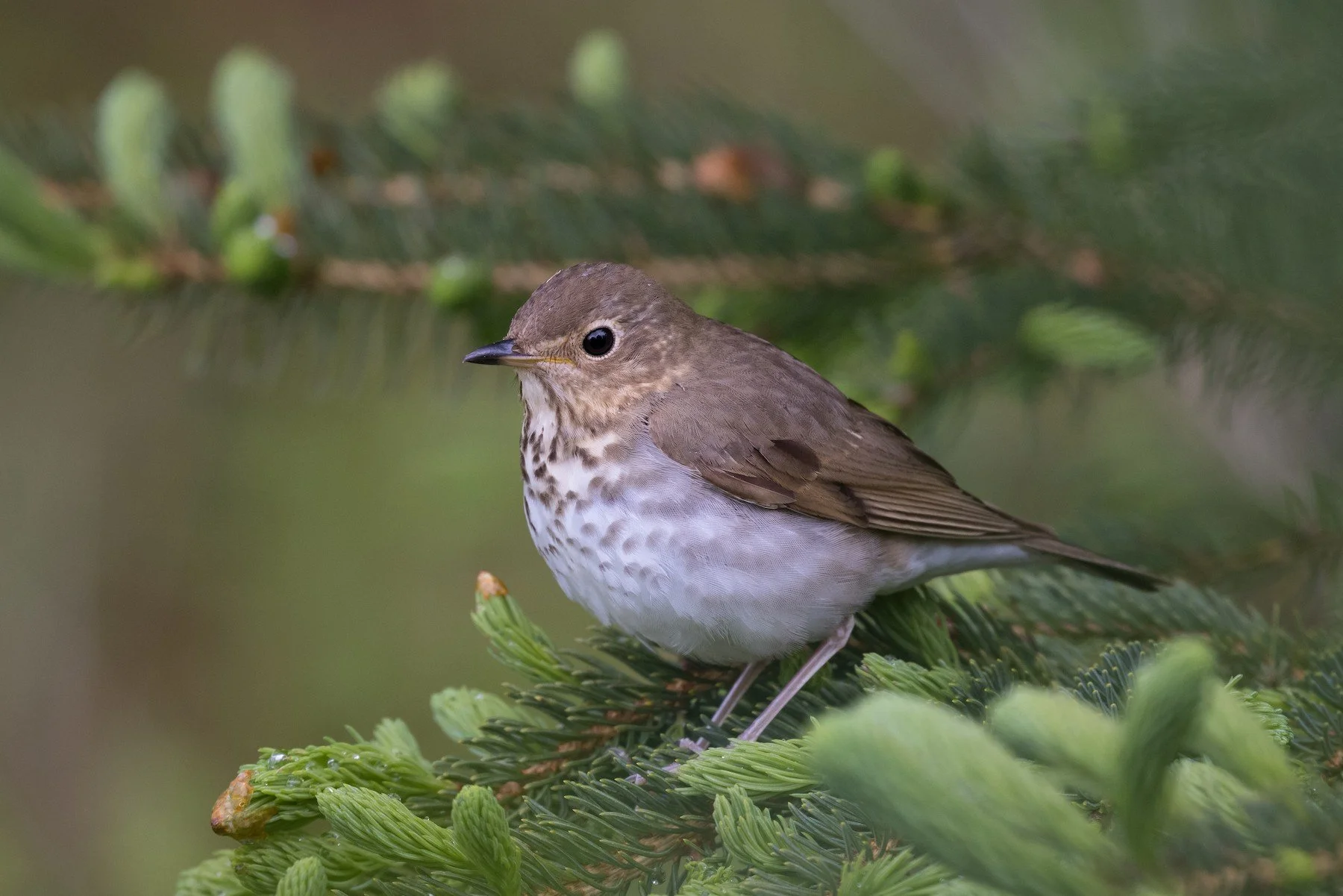
A Salmonberry Thrush (Swainson’s Thrush) - Photo taken by Macaulay Library
Olive-sided Flycatcher
Among the most conservation-significant birds recorded during the 2026 monitoring season was the Olive-sided Flycatcher. This species is a specialist aerial insectivore. It often chooses a prominent dead or living tree as a lookout, launching from it’s perch to capture flying insects before returning to the same elevated vantage point. It is particularly associated with openings within or adjacent to mature forest, wetlands, burns, riparian areas and other places where tall trees or snags overlook open airspace.
That makes the species a fascinating example of why conservation is rarely as simple as “forest versus clearing.” An Olive-sided Flycatcher may need the forest and the opening. These birds arrive in Canada in spring and begin heading south in late July and August. Some travel thousands of kilometres to wintering areas in Central and South America, including the Andes. The species is assessed as Special Concern by COSEWIC and listed as Special Concern under Canada's Species at Risk Act. Its repeated detection during HAT monitoring makes it an especially valuable species to continue watching over time.
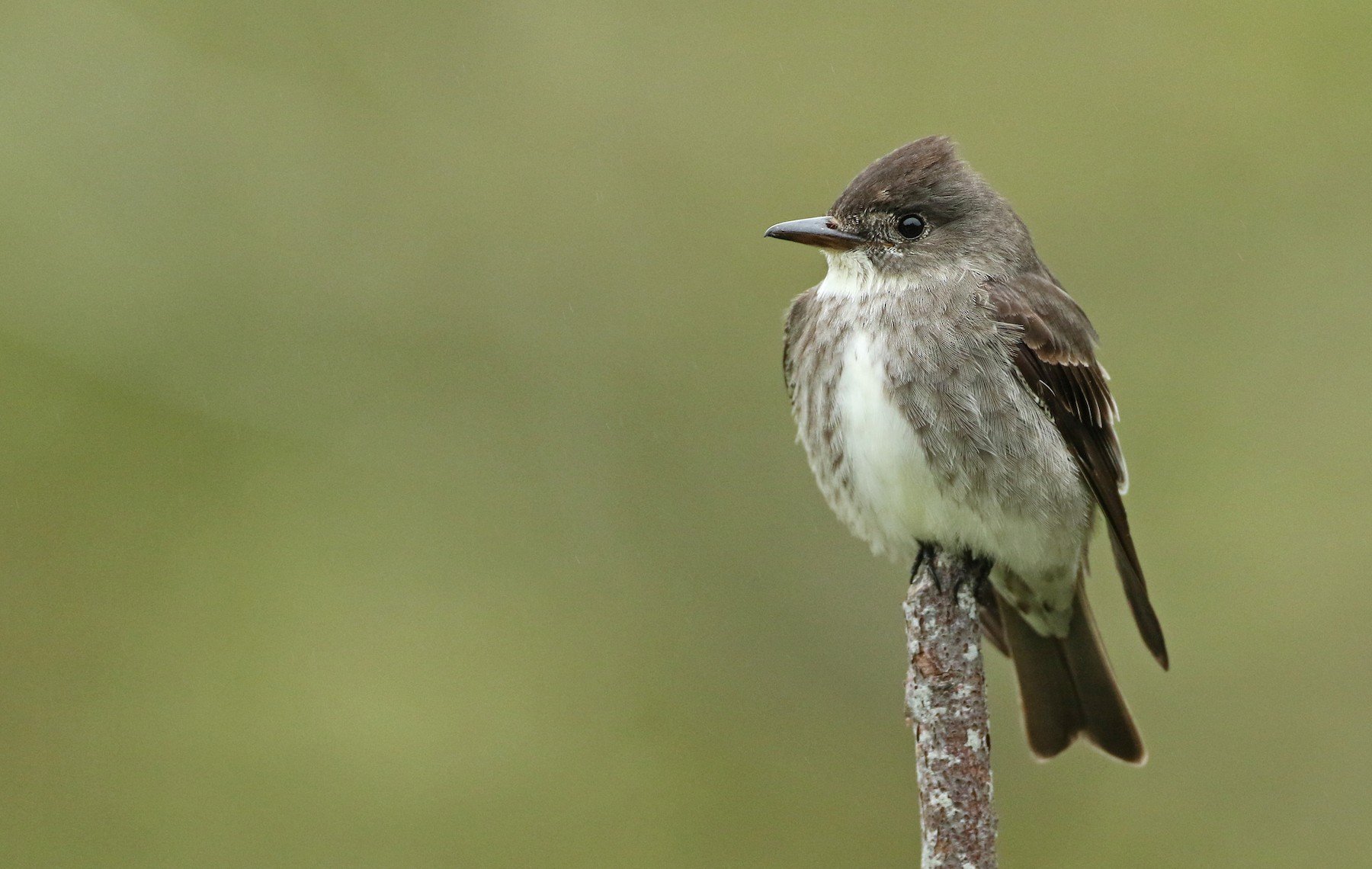
An Olive-sided Flycatcher - Photo taken by Macaulay Library
Purple Martin
Purple Martins are another particularly interesting species in the HAT monitoring record. They are the largest swallow in North America and, like the Olive-sided Flycatcher, make their living almost entirely by catching insects in flight. But Purple Martins have a very different relationship with people.
In British Columbia, natural nesting cavities became increasingly scarce as old shoreline trees and snags disappeared and historic wooden pilings were replaced. By the 1980s, the species had nearly disappeared from the province. A remarkable volunteer-led recovery effort has since helped restore the western population, with artificial nest boxes now supporting the vast majority of nesting Purple Martins in B.C.
They are long-distance migrants. British Columbia's western Purple Martins migrate to southeastern Brazil for the winter. Their story is a powerful example of how habitat protection and active stewardship can work together. Protecting shorelines, wetlands and open areas helps maintain feeding habitat, while carefully managed nesting structures can replace some of the natural cavities that have been lost.
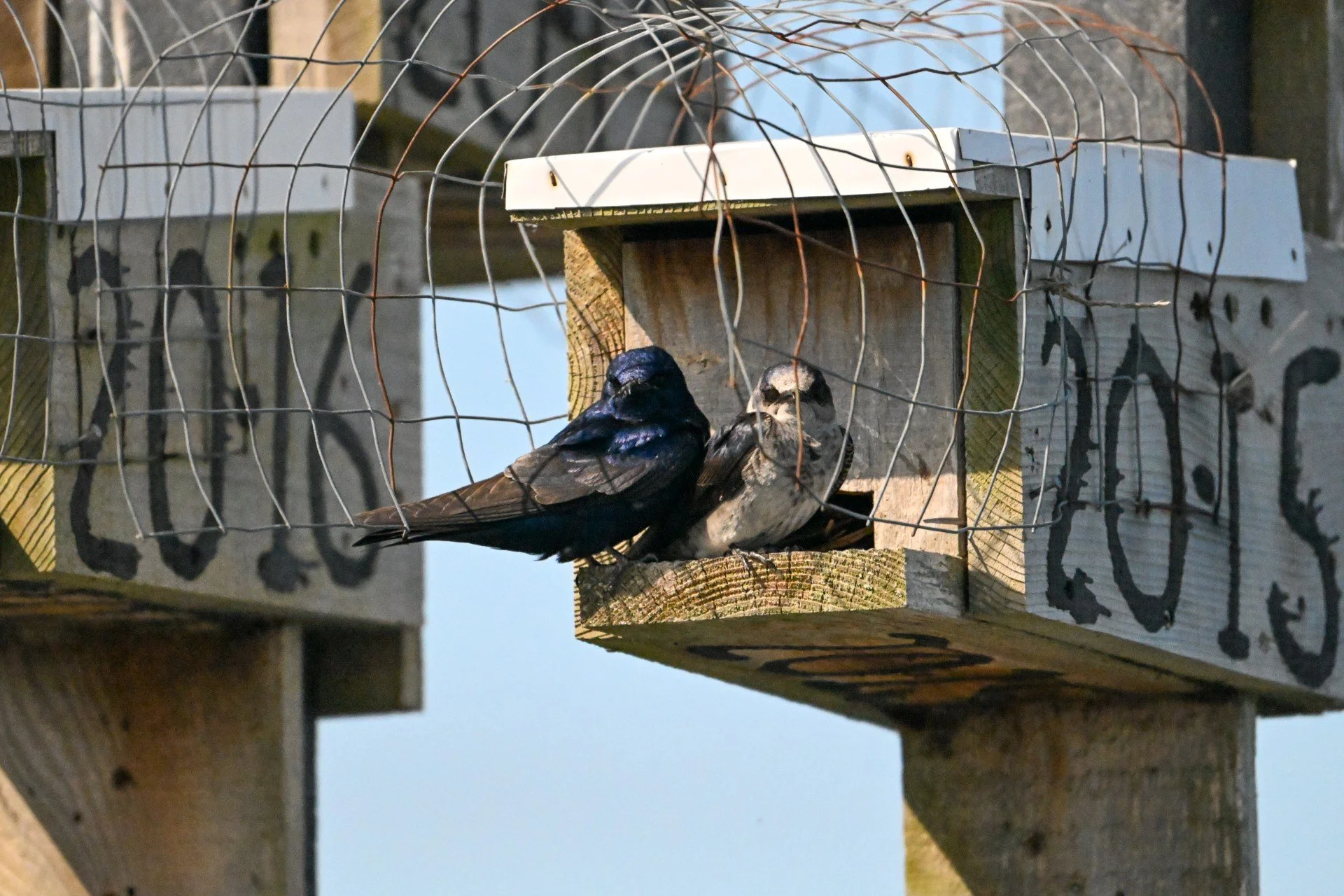
A Purple Martin - Photo by Trentön Schulz-Franco, Land Protection Coordinator
Why do we see these birds so often on HAT-protected lands?
The simplest answer is: because of these beautiful habitats. Birds don't recognize property boundaries. A Chestnut-backed Chickadee doesn't know whether it is flying across a covenant boundary. A Salmonberry Thrush doesn't distinguish between protected and unprotected forests. A Red Crossbill follows the cone crop, just as an Olive-sided Flycatcher follows the insects. But the quality and continuity of habitat across those boundaries matters enormously.
Protected lands can host the features that birds need: Old trees provide nesting cavities, food, and structure. Snags and fallen wood support insects and cavity-nesting species. Native vegetation provides berries, seeds and insect habitat. Wetlands & ponds provide food, water and migration habitat. Forest openings & edges create feeding opportunities for aerial insectivores. Connected habitat allows birds & other wildlife to move through the landscape.
Birds as a window into land protection
A bird list can look deceptively simple. One line says Brown Creeper — 2. Another says Red Crossbill — 21. In reality, each observation is a window into an ecological relationship: a bird finding food beneath bark, a pair searching for a cavity, a flock following a conifer seed crop, or a migrant arriving after travelling thousands of kilometres. That is what makes bird monitoring useful for land protection. At the very core of it, birding is observing and being present on the lands we walk.
The 15 surveys conducted between May and August 2026 are not, by themselves, enough to tell us whether bird populations are increasing or declining on HAT-protected lands. They are a baseline, a record against which future observations can be compared. As monitoring continues, we can begin to ask more detailed questions;
Which birds return year after year? Which species are using protected lands during migration? Are species of conservation concern continuing to use these landscapes? And, over decades rather than months, how does the bird community change as protected lands remain protected? The next time you hear a chickadee in the canopy, see a flicker working through the leaf litter, hear a Salmonberry Thrush singing from the understory, or spot a Red Crossbill high in a Douglas-fir. Remember, there is a much larger story behind that bird than meets the eye.